
Know Your Rights: The 10th Amendment
We can't protect what we don't understand. A month-long look at the Constitution, one amendment at a time.


When Washington passes a law, can it force your county sheriff to enforce it?
In 1981, James “Jim” Brady was seriously wounded during an assassination attempt on President Ronald Reagan.
Congress passed the Brady Handgun Violence Prevention Act in 1993, after years of lobbying by Brady and his wife. A case heard by the U.S. Supreme Court in 1997 challenged a section of the Brady Bill.
The case discussed in today’s post deals with two culturally important themes: federalism and “states’ rights,” as well as the national problem of gun violence.
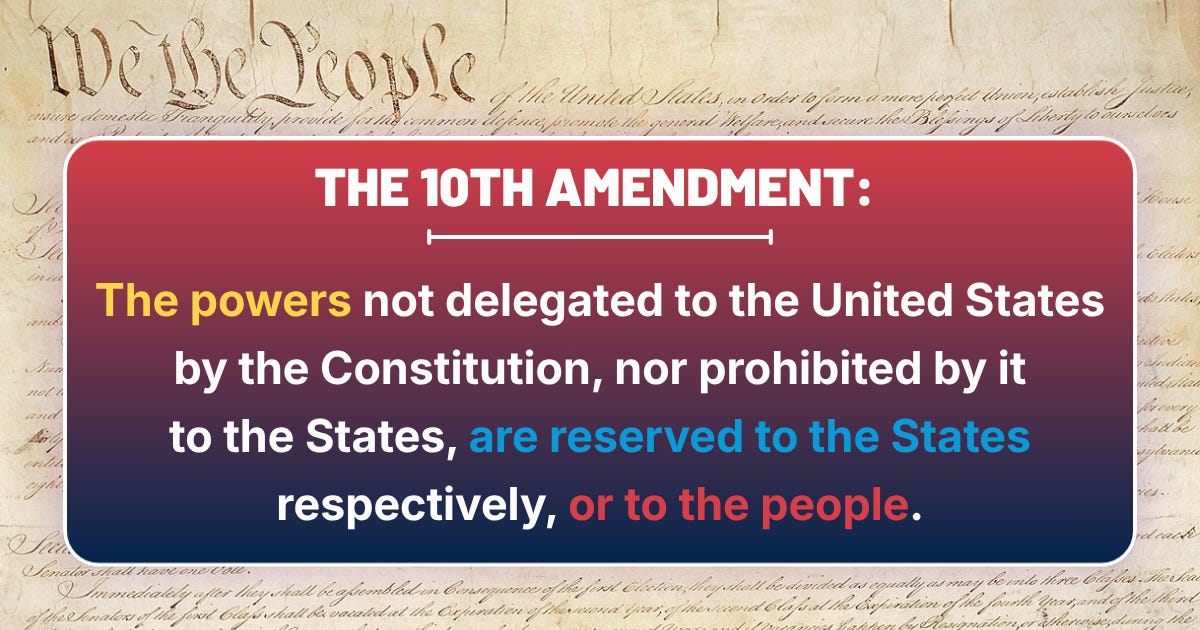
Text:
The powers not delegated to the United States by the Constitution, nor prohibited by it to the States, are reserved to the States respectively, or to the people.
Recent Case:
The Brady Handgun Violence Prevention Act required the U.S. Attorney General to create a national system for conducting background checks on prospective handgun buyers.
Also, until the national system was in place, the Attorney General was to “command the chief law enforcement officer” of each local jurisdiction to conduct such checks and perform related tasks on an interim basis.
Sheriffs Jay Printz of Montana and Richard Mack of Arizona challenged the command on the grounds that it forced state officers to carry out federal law, a violation of the Tenth Amendment.
The Supreme Court ruled for Printz and Mack, 5-4.
Writing for the majority Justice Antonin Scalia cited many previous court cases and the “historical understanding of the Tenth Amendment” Scalia added:
“The Framers rejected the concept of a central government that would act upon and through the States, and instead designed a system in which the State and Federal Governments would exercise concurrent authority over the people.”
Justice John Paul Stevens wrote a dissenting opinion, suggesting there were other parts of the constitution that would give weight to Congress’ authority in this case.
“The Tenth Amendment,” Stevens argued, “contains no additional limitations on federal power, serving merely to clarify that the Government has only those powers granted by the Constitution.”
Stevens was very concerned with the ability of the federal government to respond to a national emergency.
“I do not believe there is anything in the 10th amendment, in historical understanding and practice, in the structure of the Constitution, or in the jurisprudence of this Court, that forbids the enlistment of state officers to make that response effective.”
🐦
Text Sourced From:
Amendment: constitutioncenter.org
Historical Background: constitutioncenter.org
Recent Case Researched & Written by:
D.C. Davis, Cardinal Scribe
Double-check your voter registration here:
https://vt.ncsbe.gov/RegLkup
Learn more about the Forsyth County Democratic Party on our website: https://fcdpnc.org